
Backache
LEARN MOREBackache
stability: supports the trunk, upper limbs and head; mobility: allows all movements of the trunk and head; containment: protect the spinal cord.
These functions contradict each other (stability-standing still is the opposite of mobility-moving). So this structure is strong but also extremely complex, with a very sophisticated control system. Its functioning depends on the one and only “on-board computer”: the brain that manages the correct balance of the forces. The loss of this balance implies the onset of pain, which signals that the back is “out of control”, “out of shape”.
Injury
Causes
Serious causes of back pain are very rare (less than 1 in 300 cases) and a medical examination is enough to identify them. It is therefore important not to panic: sooner or later everyone suffers from back pain.
Treatments
Nine out of ten patients recover within one month of the onset of pain, regardless of whether or not they have undergone treatment: therefore, it is not always necessary to rush to the specialist at the first signs of back pain. However, even if it heals on its own the pain should not be ignored: even if linked to almost always a trivial cause, relapse is, in fact, often frequent. This is precisely what makes prevention essential. In any case, relapse is not a sign of something serious, but only of the recurrence of a problem we are predisposed to. Treatment with drugs, physical or manual therapies is not always decisive, although it is often a valid help. Even if the pain does not go away, it does not mean that the situation is serious: in fact, there is no correlation between the amount of pain and the amount of damage. However, the therapies are only needed in case of acute pain, but have no preventive effect.
Exercises
- If you are recovering from a back problem, follow only the exercises recommended by the
doctor or physiotherapist to avoid the risk of further injury. - Practice every day. Occasional and excessive exercise can be harmful
for your back. Make sure you have 30 minutes a day, preferably
15 in the morning and 15 in the evening. - Don’t overdo it at first and stop exercising if you experience repeated pain in the back
back or leg. Consult your doctor or physical therapist if you experience pain during
physical activity. - Always warm up your muscles for 2-3 minutes before starting any physical activity.
Try walking in place while moving your arms.
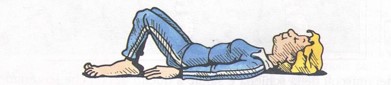
Starting position for some of the exercises.
KNEE TO CHEST
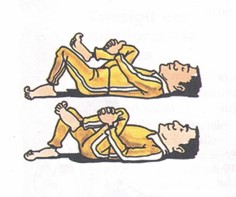
To stretch your hips and back:
- Assume the starting position.
- Bring your right knee to your chest.
- Use your hands to hold your knee and count to 5.
- Release.
- Repeat 5 times.
- Repeat steps 1 to 4 with the left leg.
Note: Do not lift your legs by helping yourself with your abs and buttocks.
THE PELVIC CLOCK
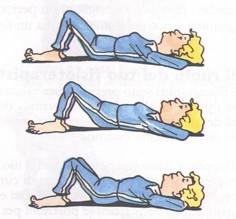
To strengthen the front and back muscles and improve mobility:
- Assume the starting position but bring your hands, palms up, under your head.
- Squeeze your abs and buttocks.
- Push your hips slowly toward the ceiling until your lower back is flat on the floor.
- Hold the position and count to 5.
- Release.
- Repeat 5 times.
PARTIAL LIFTING
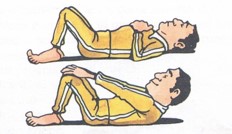
To strengthen the abdominal muscles:
- Assume the starting position, but bring your hands to your chest.
- Slowly lift your head and neck towards your upper chest.
- Extend both hands forward and rest them on your knees.
- Hold the position and count to 5.
- Slowly return to the starting position.
- Repeat 5 times.
Note: keep your head in line with your shoulders.
PLACE YOUR ELBOWS
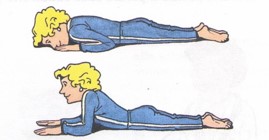
To maintain normal lumbar curve and relax back muscles:
- Lie face down as shown.
- Lean on your elbows.
- Hold this position for 10-20 seconds.
- Return to starting position and relax for one minute.
- Repeat 5 times.
Note: Keep your back completely relaxed.
LUMBAR ROTATION
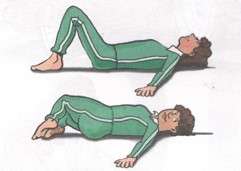
To stretch and strengthen the back muscles:
- Assume the starting position, however extending your arms to the sides, with your palms facing down.
- Slowly drop both knees to one side and rotate your head in the opposite direction; keep your shoulders flat on the floor.
- Hold the position and count to 5.
- Repeat 10 times, slowly alternating sides.
- Return to the starting position.
THIGHS RELEASE
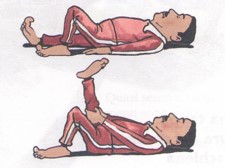
(Consult your doctor before undertaking this exercise.)
- To stretch the hamstrings:
- Assume the starting position, but extending the right leg.
- Slowly lift your right leg as far as you feel, supporting it with your hands.
- Hold the position and count to 15.
- Return the leg to the floor.
- Repeat 5 times.
- Repeat steps 1 to 5 with the left leg.
Note: Use your hands to gently bring the leg towards you.
HIPS RELAXATION
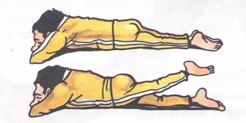
Advanced exercise (Ask your doctor or physical therapist for advice!)
- To stretch and strengthen the hips, buttocks and back muscles:
- Lie on your stomach as shown (it may be helpful to have a small pillow under your stomach).
- Extend your left leg and squeeze your buttocks.
- Slowly lift your left leg.
- Return the leg to the floor.
- Repeat 5 times.
- Repeat steps 2 to 5 with the right leg.
Note: Keep your pelvis flat on the floor as you lift your leg. Keep your leg straight.
Preventio
- Exercise regularly and avoid sitting for too long.
- Do not smoke.
- Maintain good posture.
- When lifting weights, keep your back straight and bend your legs.
- Use a mattress that suits you, neither too soft nor too hard.
Click here for more tips.